Jugendkulturfestival 2019
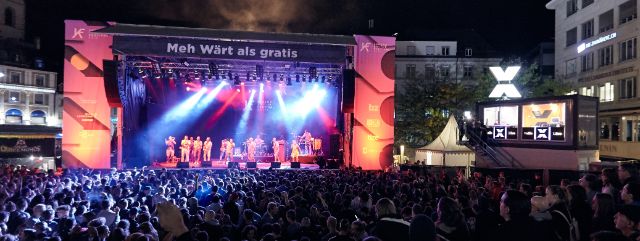
Das Jugendkulturfestival Basel (JKF) fand am 6. und 7. September 2019 in der Basler Innenstadt statt. Radio X sendete auch 2019 live vom JKF!
Auch 2019 war Radio X wieder mit einem Studio-Container auf dem Barfüsserplatz hautnah dabei und sendete folgende Konzerte von der Barfi-Bühne live auf dein Device:
Projektleitung: Claire Micallef
Freitag, 6.September 2019
18.00h Weird Fishes
19:30h Café da Manhã
21:15h Dritte Stock Records
22:45h Pyro & Schwellheim
00:00h Les Touristes
Samstag, 7.September 2019
15:00h Boxitos
17:20h Arbajo Jairus & Them Lovers
19:00h Emilia Anastazja
20:15h Annie Goodchild
21:30h Carvel'
23:00h Don't Kill the Beast
00:15h Naim
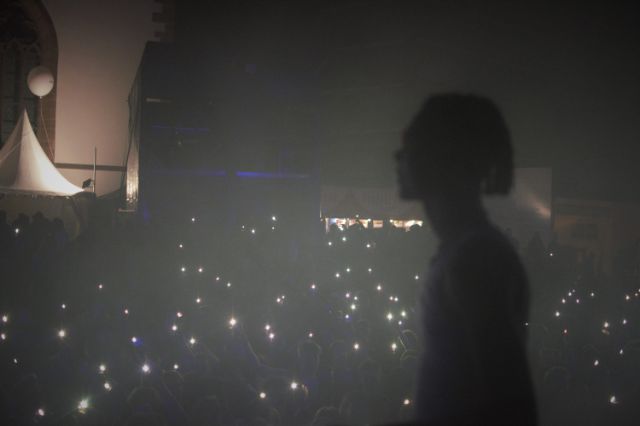
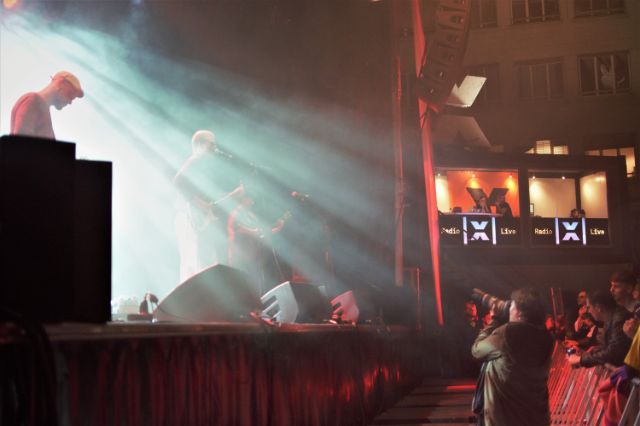
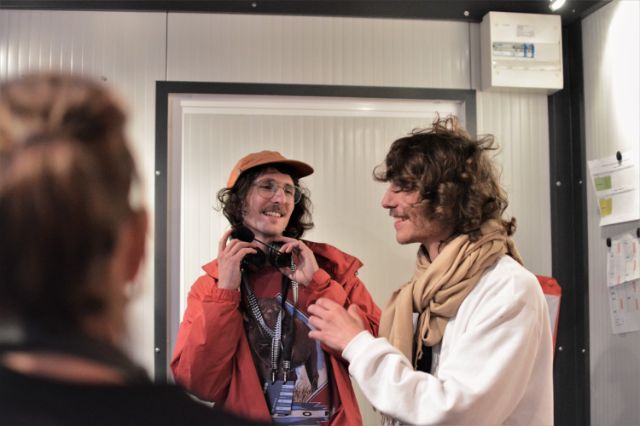
Zwischen den einzelnen Konzerten war bei uns natürlich nicht tote Hose. Wir haben die einzelnen Künstlerinnen und Künstler aus allen Sparten des Festivasl zu uns in unseren Sendecontainer bestellt und redeten mit ihnen über Bierduschen, Einhörner und natürlich auch noch ein wenig über ihre Performance am JKf. Dazwischen gabs wie üblich den dopesten Sound von Basel!
Hier noch ein Überblick über unser Interview-Programm:
Freitag, 6. September
17:05 - JKF OrganisatorInnen
17:35 - Weird Fishes
18:05 - Von Oben Herab
19:05 - Nomuel
20:15 - Mono Mojo
21:05 - Moonpools
22:00 - L'Arbre Bizarre
22:30 - Keine Helden
23:30 - Zatokrev
Samstag, 7. September 2019
15:40 - The Movement
17:00 - Hobby Lobby
18:00 - Amixs
18:25 - Emilia Anastazja
18:50 - Totem Nevada
19:45 - Gina Été
20:05 - Echolot
21:05 - Dolphin Squad
22:20 - Asbest
22:50 - Suicide Salmon
00:00 JKF OrganisatorInnen
Radio X mit drei Talks am JKF - in der Offenen Kirche Elisabethen
Samstag 7.9.2019 16:00 Nachhaltigkeit und Festivals
Schonmal an einem Festival beim Aufräumen dabei gewesen? Festivals haben den schlechten Ruf unverhältmässig hohe Abfallhaufen zu hinterlassen. Luca Frabotta umreisst mit seinen Gästen das Thema Nachhaltigkeit und Klimaschutz in Bezug auf Musikfestivals, im konkreten Fall den Umgang damit am Jugendkulturfestival in Basel.
JKF2019 Talk: Nachhaltigkeit und Festivals
Festivals produzieren Müll. Was können Festivals dagegen tun, um nachhaltig zu sein?
Samstag 7.9.2019 17:00 Erste Schritte auf die Bühne – Eine Band erzählt
Wie ist es, als junge Band den Schritt aus dem Proberaum zu wagen? Was sind Stolpersteine und Chancen? Marcello Capitelli erörtert zusammen mit der jungen Band Mallumi die Herausforderungen eines Neulings in der Musikszene.
JKF2019 Talk: Erste Schritte als Band - Mallumi
Die Ersten Schritte als Band sind mit einigen Kniffs verbunden. Larissa von Mallumi erzählt.
Samstag 7.9.2019 18:00 Sexuelle Belästigung - Wenn ein Nein nicht ausreicht
Moderation: Claire Micallef
Eine Hand auf dem Hintern, sexuelle Kommentare oder ein Typ, der sich beim Tanzen von hinten an dich schmiegt. Kommt dir das bekannt vor?
Um gegen sexuelle Belästigung im Ausgang vorzugehen, wurde 2016 in der Stadt Münster das Luisa-Projekt ins Leben gerufen. In der Schweiz wurde die Kampagne von Städten wie Winterthur oder Zürich adaptiert und im Herbst will die Opferhilfe beider Basel die Kampagne nun auch in Basel starten. Was bringt das Luisa-Projekt konkret? Und was kann Frau und Mann gegen sexuelle Belästigung tun? Wir reden mit Betroffenen, mit Experten und mit euch, dem Publikum.
JKF2019 Talk: Sexuelle Belästigung
Claire Micallef eruiert mit ihren Gästen die Thematik von Sexueller Belästigung im Ausgang und an Musikfestivals. Was kann dagegen unternommen werden?
#badtastehenna

Wir wollten euch am JKF alle etwas aufhübschen! Deswegen gab es an unserem Stand in der Offenen Kirche Elisabethen eine Henna-Tattoo-Session der etwas anderen Art. Kulturschaffende, die am JKF aufgetreten sind, waren die Tattoo-Artists, du ihre Leinwand. Schöne Schnörkel und Mandalas waren allerdings fehl am Platz, denn unsere Artists sind Masters of Trash. Und auch bei der Wahl des Motivs hattest du nicht viel mitzureden. Die lag ganz beim "Wheel of Destiny". Einzig die Wahl des Orts, an dem du dein Henna-Tattoo willst, die überliessen wir dir noch. Und, siehe da, einige haben sich getraut!
Einen Eiblick in das kuriose Sammelsurium an #badtastehenna findest du auf unserem Instagram Account.
unsere Insta-Story:
.jpg/jcr:content/Scannen%20(002).jpg)
Echokammern des Unterbewussten: Anastasia Coope im Interview
Die Musik der Freak Folk Sängerin bewegt sich langsam, beinahe zeremoniell. Die Lieder entfalten sich wie sorgfältig in einen Rahmen gesetzte Objekte: einfache Bilder, aufgehängt in einer Atmosphäre, die zugleich uralt und seltsam zeitgenössisch wirkt. Im Februar spielte sie ihr erstes und einziges Konzert in der Schweiz im Klub Bad Bonn - wir trafen sie dort zum Interview. von Mirco Kaempf
Interview mit Anastasia Coope 2026
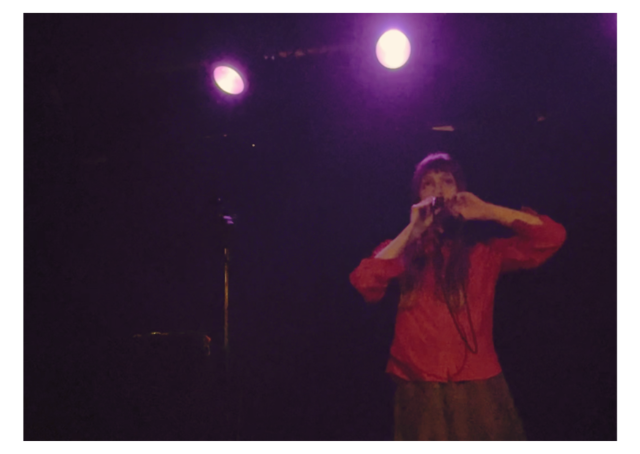
Die NY Freak Folk Künstlerin Anastasia Coope im Interview im Bad Bonn Klub in Düdingen am 21. Februar 2026
Still life painting has always carried a quiet contradiction: beauty arranged beside decay, permanence beside mortality. As art moves forward, every generation inherits these images and asks the same question again. How many stories are left to tell under the same burning sun—and how, exactly, does one remain original?
Listening to New York singer Anastasia Coope, the question feels newly unsettled.
Her music moves slowly, almost ceremonially. Songs unfold like objects placed carefully in a frame: simple images, suspended in an atmosphere that feels both ancient and strangely contemporary. There is something of an old wisdom in the way her voice moves through abstraction, where stories and symbols seem to dissolve and reform, returning slightly altered each time.
Though the songs themselves feel timeless, Coope is currently moving quickly. She is touring across Europe, performing material largely drawn from her recent EP DOT, which she released last October on her own label.
Her path there has been unusual. Coope began recording songs alone in a bare apartment before being picked up by the independent label Jagjaguwar, which released her 2024 debut album Darning Woman. The collaboration brought wider attention, but ultimately left her dissatisfied. She has since returned to Bonzo, a self-made label she originally used to host small art and music events wherever she happened to live.
Coope is a singer, musician, painter, and avant-garde folk artist with strong ideas about how her work should exist. Joined live by drummer Moses Archuleta, she stretches her songs outward, turning small musical gestures into something expansive.
Raised in Cold Spring in New York’s Hudson Valley—surrounded by rural folk traditions and far removed from laptop-driven production—she later attended Pratt Institute in Brooklyn to study fine art. The result is a musical language that feels distinctly her own, largely indifferent to passing trends.
I finally saw her live at Bad Bonn in Düdingen, her first and only Swiss date on this tour. The venue is well known for its small but highly regarded festival of the same name. Reaching it involves a regional train and a twenty-minute walk through quiet countryside.
Inside, the room feels intimate, almost domestic. Before the show begins, we sit down for a conversation.
Your lyrics feel like poems—castles falling, sinking floats. I sense eternity lingering. Are you melancholic, or just sober? Does death feature in your music?
Anastasia Coope:
I actually don’t think it does. I was very afraid of death as a kid—it really paralyzed me for a couple of years—but I think I got over that around age thirteen. Artistically, I’m not consciously thinking about death or melancholia. My writing isn’t autobiographical either. Even if it seems that way, I’m mostly synthesizing different stories or fragments of information I’ve absorbed. I’m just the one singing them. They’re pulled from many different places.
You’ve described songwriting almost like beginning with an empty canvas. What does a painting need to have to really capture you?
Anastasia Coope:
It’s hard to describe exactly what I’m looking for, but there are definitely things in contemporary painting that immediately turn me off. Certain visual languages just don’t resonate. Too much figurative work with heavy patterns and bright colors feels playful or excessive. It just doesn’t connect. Often, artists imitate each other instead of trying to reach something more real.
So, styles imitating themselves instead of striving for authenticity?
Anastasia Coope:
Yes. Usually it’s an immediate sense of discernment. There are painters whose work I only understand after hearing them talk about it. But most of the time, you can tell when someone is making work because they feel inclined to, rather than simply referencing other things.
It’s almost like painting a still life—placing something ordinary in an eternal space so it transforms. Is that similar to what you’re doing with words?
Anastasia Coope:
Yes. I try to use words in a universal way, so that many different storylines could apply. I care about the poetry of the words and how they fit together, but I’m never sitting down thinking, “I feel this and I’m going to write about it.” I’ll combine sentences instinctively, and afterward I might see that they form something meaningful.
During our conversation she mentions, almost casually, that she was deeply afraid of death until she was about thirteen. That fear has long since passed. When she sings now, there is little of the romantic solemnity one might associate with artists like William Blake. Instead, her approach feels observational—almost forensic.
Coope isn’t especially melancholic. Her music carries a kind of cosmically charged sobriety: looking at things again and again until looking becomes seeing. Only then does the layered choir of her own voice begin to emerge.
One of her earliest songs illustrates this approach well. Woke Up And No Feet reportedly began with a simple observation: Coope looking at the frame of a painting she once made—a boy whose feet were missing from the composition. From there came a stream of questions:
Wonder how hooded boy would be understood if he woke up with no feet /
You know that what he does is good /
So why is she considered good as well?
Paul Klee wrote that art “makes things visible.” Coope’s songs work the same way: ordinary objects—floating, crumbling, fragmented—are framed until the familiar becomes strange. Moments stretch; time thickens. At the edges, a larger meaning lingers, even if it never fully reveals itself.
Do you believe in universal truth, or is everything subjective?
Anastasia Coope:
I do believe in universal truth. It’s tricky, though, because then you start asking who understands it. I use it as an internal compass, but I try not to let it make me overly judgmental. It can get complicated if you think about it too granularly.
As an artist, are you searching for these truths, or just putting them out there for people to deal with?
Anastasia Coope:
Probably the latter. Being an artist is about recognizing whatever version of universal truth you hold. The challenge isn’t having it—it’s translating it.
Through the layering of her voice, Coope often creates something like an echo chamber of the subconscious. Some listeners compare the effect to imagined medieval singing—though the reality of that music is mostly lost to history. At times her sound feels less postmodern than premodern, as if it were drifting in from some earlier moment.
At moments, her music recalls the outsider intimacy of Connie Converse or the strange solitude of Jandek. At other times the stacked voices feel closer to the choral experiments of Björk.
Yet even those comparisons feel incomplete. Coope’s music occupies its own peculiar clearing.
Could you imagine forming your own band?
Anastasia Coope:
Yes, that’s the goal. But I’d want to write music with a band in mind first. I worry about losing ownership of the work. Ideally I’d write a record imagining four players and then have people learn the material. Hopefully I can afford to do that soon.
You released the EP on your own label after previously being with a larger indie label. What’s better about doing it this way?
Anastasia Coope:
Fundamentally, I don’t think I could ever be on someone else’s label long-term. I can’t relinquish control. I’m sure it works for others, but I prefer being responsible for everything. I realized I can’t delegate artistic responsibility in a way that feels right for me.
The world often feels ruined by people with huge egos. Why aren’t you afraid of your own?
Anastasia Coope:
I mostly impose it on myself. Every artist has an ego. At this point, I feel like I have it under control. I try to use the productive side—to create situations that allow for better art, including by other people.
Last question: are you worried about the world, or do you see it more cosmically—like stars that eventually burn out?
Anastasia Coope:
Both. Everything feels terrible a lot of the time—especially this past year. All we can do is act decisively day to day, in ways that align with our morals. At the same time, there’s the universal reality of becoming dust. But people are suffering right now in immediate ways, and sometimes it’s hard to take the cosmic view when that’s the case.
Later that evening at Bad Bonn, her voice multiplies in the small room—one melody folding quietly into another. The audience as far as I can see is engulfed, sitting in front of the stage, like in a sermon. The songs rarely explain themselves. Instead, they leave small openings, like objects placed carefully in a still life. The longer you listen, the more they seem to move.
Verwandte Artikel
Chrüsimüsi Records in Biel: Schräge Sounds für schöne Seelen
Mitten durch Biel verläuft der Röstigraben – doch manchmal klingt dieser wie ein gemeinsamer Akkord. Chrüsimüsi Records zeigt, wie aus Sprachgrenzen Begegnungen werden, und lädt mit dem Dauerwelle Festival (13. + 14.3.) dazu ein, die Stadt und ihre Szene neu zu entdecken.
Lael Neale: "Maybe the museums should burn"
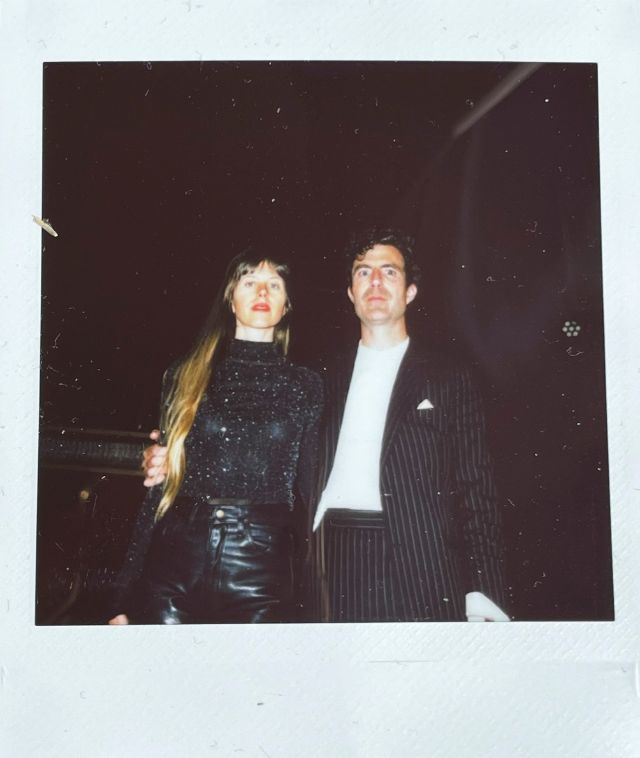
A brief interview with American chanteuse Lael Neale on the beauty (& ugliness) of personal experience composed in a universal language, all on the trails of her very own, dead poet society. Some thoughts recorded after attending her gig at DOKA, Amsterdam on a Monday night 19th of may 2025.

Album der Woche: Darning Woman von Anastasia Coope
Ein kurioses, um nicht zu sagen, ein beinahe aus der Zeit gefallenes Debütalbum hat am Freitag die 21-jährige New Yorkerin Anastasia Coope herausgebracht. Auf 'Darning Woman' transformiert sie Ideen von Geschlecht, Songwriting und macht die eigene Stimme zum choralen LoFi Pinselstrich.
say cheese!
last but not least: die Fotobox-Fotos vom JKF 2019
Sponsoren
Die Live-Übertragung von Radio X am Jugendkulturfestival 2019 wurde unterstützt durch die Abteilung Kultur des Präsidialdepartements Basel-Stadt
Die Umsetzung der der Live-Übertragung 2019 fand in Zusammenarbeit mit folgenden Partnern statt:


.png/jcr:content/magnolia-medium.png)