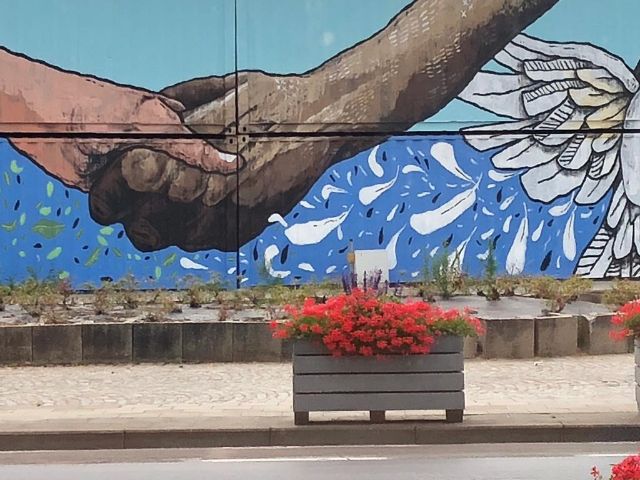
Woche gegen Rassismus 2023
Mit dem Schwerpunktthema Antibalkan-Rassismus
Dank der finanzellen Unterstützung der kantonalen Fachstelle für Integration und Antirassismus und der eidgenössischen Fachstelle für Rassismusbekämpfung setzt Radio X vom 20. bis 26. März 2023 die Woche gegen Rassismus um.
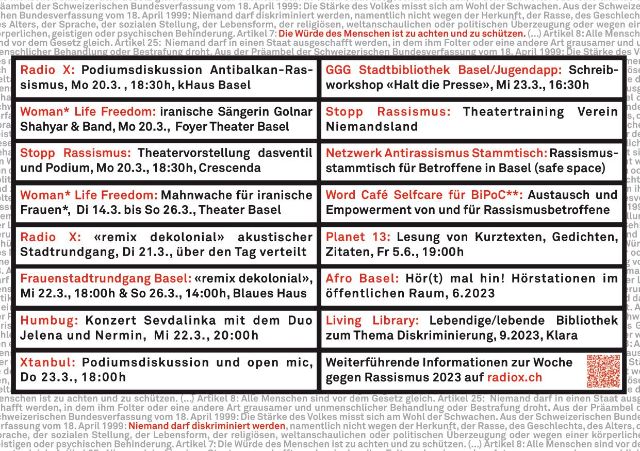
Podiumsdiskussion «Antibalkan-Rassismus» mit anschliessendem Apéro
am Montag, den 20. März 2023 um 19.00 Uhr im Forum des kHaus in Basel
mit einer Begrüssung von Jenny Pieth (Co-Leiterin der Abteilung Gleichstellung und Diversität im Präsidialdepartement) und einem Inputreferat von Myrsini Arvanitis (Historikerin)
anschliessend eine Podiumsdiskussion mit Arzije Asani (Audiovisual Storyteller) und Endrit Sadiku (Projektleiter Jugendapp Basel), moderiert von Merita Shabani (baba news)
Darüber hinaus engagieren sich folgende Partnerorganisationen mit einem antirassistischen Projekt in Kooperation mit Radio X:
- Mo, 20. März im Foyer Theater Basel: Woman* Life Freedom, iranische Sängerin Golnar Shahya und Band
- Mo, 20. März um 18.30 Uhr in der Villa Crescenda: Einfrautheaterstück von dasventil in Zusammenarbeit mit Stopp Rassismus und Crescenda. Im Einfraustück macht sich Bettina Zimmermann, Leiterin des nationalen Kompetenzzentrum, Gedanken, wie man Menschen kompetent willkommen heissen kann. Per Audioeinspielung kommen Geflüchtete mit Unerhörtem zu Wort. Anschliessend Podium (moderiert von Adelina Arendarska) und Apéro.
- Vom Di, 14. bis So, 26. März im Theater Basel: Mahnwache für iranische Frauen*
- Di, 21. März über den Tag verteilt auf Radio X: "remix dekolonial", akustischer Stadtrundgang
- Mi, 22. und So, 26. März vor dem Blauen Haus in Basel: Frauenstadtrundgang Basel "remix dekolonial"
- Mi, 22. März um 20 Uhr im Humbug: Konzert von Sevdalinka mit dem Duo Jelena und Nermin
- Do, 23. März um 18 Uhr in der Kunsthalle Basel: Podiumsdiskussion und open mic von Xtanbul
- Mi, 23. März um 16.30 Uhr: Schreibworkshop "Halt die Presse" der GGG Stadtbibliothek Basel/Jugendapp
- Fr, 28. April um 19.00 Uhr in der Union, Oberer Saal: Theatertraining, offener Theaterworkshop mit Fokus auf die Themen Rassismus, Diskriminierung. Verein Niemandsland in Kooperation mit Stopp Rassismus
- März/April: Netzwerk Antirassismus Stammtisch, Rassismusstammtisch für Betroffene in Basel (safe space)
- März/April: World Café Selfcare für PiPoC**: Austausch und Empowerment von und für Rassismusbetroffene
- Fr, 5. Juni um 19.00 Uhr: Planet 13 lädt ein zur Lesung von Kurztexten, Gedichten und Zitaten
- Juni 2023: Hör(t) mal hin! Hörstationen im öffentlichen Raum von Afro Basel
- September 2023 in der Klara: Living Library, lebendige/lebende Bibliothek zum Thema Diskriminierung


.jpg/jcr:content/Scannen%20(002).jpg)
Echokammern des Unterbewussten: Anastasia Coope im Interview
Die Musik der Freak Folk Sängerin bewegt sich langsam, beinahe zeremoniell. Die Lieder entfalten sich wie sorgfältig in einen Rahmen gesetzte Objekte: einfache Bilder, aufgehängt in einer Atmosphäre, die zugleich uralt und seltsam zeitgenössisch wirkt. Im Februar spielte sie ihr erstes und einziges Konzert in der Schweiz im Klub Bad Bonn - wir trafen sie dort zum Interview. von Mirco Kaempf
Interview mit Anastasia Coope 2026
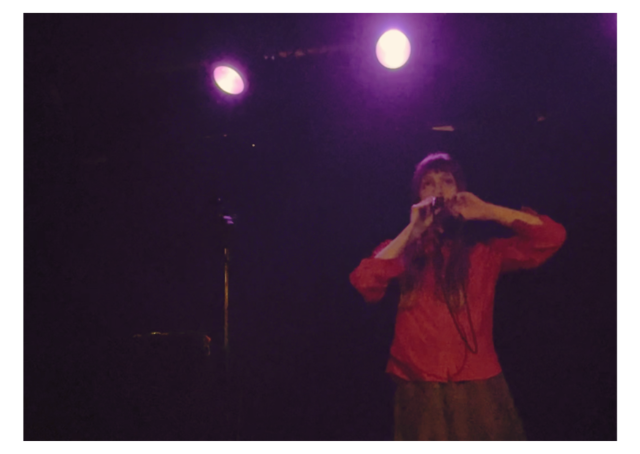
Die NY Freak Folk Künstlerin Anastasia Coope im Interview im Bad Bonn Klub in Düdingen am 21. Februar 2026
Still life painting has always carried a quiet contradiction: beauty arranged beside decay, permanence beside mortality. As art moves forward, every generation inherits these images and asks the same question again. How many stories are left to tell under the same burning sun—and how, exactly, does one remain original?
Listening to New York singer Anastasia Coope, the question feels newly unsettled.
Her music moves slowly, almost ceremonially. Songs unfold like objects placed carefully in a frame: simple images, suspended in an atmosphere that feels both ancient and strangely contemporary. There is something of an old wisdom in the way her voice moves through abstraction, where stories and symbols seem to dissolve and reform, returning slightly altered each time.
Though the songs themselves feel timeless, Coope is currently moving quickly. She is touring across Europe, performing material largely drawn from her recent EP DOT, which she released last October on her own label.
Her path there has been unusual. Coope began recording songs alone in a bare apartment before being picked up by the independent label Jagjaguwar, which released her 2024 debut album Darning Woman. The collaboration brought wider attention, but ultimately left her dissatisfied. She has since returned to Bonzo, a self-made label she originally used to host small art and music events wherever she happened to live.
Coope is a singer, musician, painter, and avant-garde folk artist with strong ideas about how her work should exist. Joined live by drummer Moses Archuleta, she stretches her songs outward, turning small musical gestures into something expansive.
Raised in Cold Spring in New York’s Hudson Valley—surrounded by rural folk traditions and far removed from laptop-driven production—she later attended Pratt Institute in Brooklyn to study fine art. The result is a musical language that feels distinctly her own, largely indifferent to passing trends.
I finally saw her live at Bad Bonn in Düdingen, her first and only Swiss date on this tour. The venue is well known for its small but highly regarded festival of the same name. Reaching it involves a regional train and a twenty-minute walk through quiet countryside.
Inside, the room feels intimate, almost domestic. Before the show begins, we sit down for a conversation.
Your lyrics feel like poems—castles falling, sinking floats. I sense eternity lingering. Are you melancholic, or just sober? Does death feature in your music?
Anastasia Coope:
I actually don’t think it does. I was very afraid of death as a kid—it really paralyzed me for a couple of years—but I think I got over that around age thirteen. Artistically, I’m not consciously thinking about death or melancholia. My writing isn’t autobiographical either. Even if it seems that way, I’m mostly synthesizing different stories or fragments of information I’ve absorbed. I’m just the one singing them. They’re pulled from many different places.
You’ve described songwriting almost like beginning with an empty canvas. What does a painting need to have to really capture you?
Anastasia Coope:
It’s hard to describe exactly what I’m looking for, but there are definitely things in contemporary painting that immediately turn me off. Certain visual languages just don’t resonate. Too much figurative work with heavy patterns and bright colors feels playful or excessive. It just doesn’t connect. Often, artists imitate each other instead of trying to reach something more real.
So, styles imitating themselves instead of striving for authenticity?
Anastasia Coope:
Yes. Usually it’s an immediate sense of discernment. There are painters whose work I only understand after hearing them talk about it. But most of the time, you can tell when someone is making work because they feel inclined to, rather than simply referencing other things.
It’s almost like painting a still life—placing something ordinary in an eternal space so it transforms. Is that similar to what you’re doing with words?
Anastasia Coope:
Yes. I try to use words in a universal way, so that many different storylines could apply. I care about the poetry of the words and how they fit together, but I’m never sitting down thinking, “I feel this and I’m going to write about it.” I’ll combine sentences instinctively, and afterward I might see that they form something meaningful.
During our conversation she mentions, almost casually, that she was deeply afraid of death until she was about thirteen. That fear has long since passed. When she sings now, there is little of the romantic solemnity one might associate with artists like William Blake. Instead, her approach feels observational—almost forensic.
Coope isn’t especially melancholic. Her music carries a kind of cosmically charged sobriety: looking at things again and again until looking becomes seeing. Only then does the layered choir of her own voice begin to emerge.
One of her earliest songs illustrates this approach well. Woke Up And No Feet reportedly began with a simple observation: Coope looking at the frame of a painting she once made—a boy whose feet were missing from the composition. From there came a stream of questions:
Wonder how hooded boy would be understood if he woke up with no feet /
You know that what he does is good /
So why is she considered good as well?
Paul Klee wrote that art “makes things visible.” Coope’s songs work the same way: ordinary objects—floating, crumbling, fragmented—are framed until the familiar becomes strange. Moments stretch; time thickens. At the edges, a larger meaning lingers, even if it never fully reveals itself.
Do you believe in universal truth, or is everything subjective?
Anastasia Coope:
I do believe in universal truth. It’s tricky, though, because then you start asking who understands it. I use it as an internal compass, but I try not to let it make me overly judgmental. It can get complicated if you think about it too granularly.
As an artist, are you searching for these truths, or just putting them out there for people to deal with?
Anastasia Coope:
Probably the latter. Being an artist is about recognizing whatever version of universal truth you hold. The challenge isn’t having it—it’s translating it.
Through the layering of her voice, Coope often creates something like an echo chamber of the subconscious. Some listeners compare the effect to imagined medieval singing—though the reality of that music is mostly lost to history. At times her sound feels less postmodern than premodern, as if it were drifting in from some earlier moment.
At moments, her music recalls the outsider intimacy of Connie Converse or the strange solitude of Jandek. At other times the stacked voices feel closer to the choral experiments of Björk.
Yet even those comparisons feel incomplete. Coope’s music occupies its own peculiar clearing.
Could you imagine forming your own band?
Anastasia Coope:
Yes, that’s the goal. But I’d want to write music with a band in mind first. I worry about losing ownership of the work. Ideally I’d write a record imagining four players and then have people learn the material. Hopefully I can afford to do that soon.
You released the EP on your own label after previously being with a larger indie label. What’s better about doing it this way?
Anastasia Coope:
Fundamentally, I don’t think I could ever be on someone else’s label long-term. I can’t relinquish control. I’m sure it works for others, but I prefer being responsible for everything. I realized I can’t delegate artistic responsibility in a way that feels right for me.
The world often feels ruined by people with huge egos. Why aren’t you afraid of your own?
Anastasia Coope:
I mostly impose it on myself. Every artist has an ego. At this point, I feel like I have it under control. I try to use the productive side—to create situations that allow for better art, including by other people.
Last question: are you worried about the world, or do you see it more cosmically—like stars that eventually burn out?
Anastasia Coope:
Both. Everything feels terrible a lot of the time—especially this past year. All we can do is act decisively day to day, in ways that align with our morals. At the same time, there’s the universal reality of becoming dust. But people are suffering right now in immediate ways, and sometimes it’s hard to take the cosmic view when that’s the case.
Later that evening at Bad Bonn, her voice multiplies in the small room—one melody folding quietly into another. The audience as far as I can see is engulfed, sitting in front of the stage, like in a sermon. The songs rarely explain themselves. Instead, they leave small openings, like objects placed carefully in a still life. The longer you listen, the more they seem to move.
Verwandte Artikel
Chrüsimüsi Records in Biel: Schräge Sounds für schöne Seelen
Mitten durch Biel verläuft der Röstigraben – doch manchmal klingt dieser wie ein gemeinsamer Akkord. Chrüsimüsi Records zeigt, wie aus Sprachgrenzen Begegnungen werden, und lädt mit dem Dauerwelle Festival (13. + 14.3.) dazu ein, die Stadt und ihre Szene neu zu entdecken.
Lael Neale: "Maybe the museums should burn"
A brief interview with American chanteuse Lael Neale on the beauty (& ugliness) of personal experience composed in a universal language, all on the trails of her very own, dead poet society. Some thoughts recorded after attending her gig at DOKA, Amsterdam on a Monday night 19th of may 2025.

Album der Woche: Darning Woman von Anastasia Coope
Ein kurioses, um nicht zu sagen, ein beinahe aus der Zeit gefallenes Debütalbum hat am Freitag die 21-jährige New Yorkerin Anastasia Coope herausgebracht. Auf 'Darning Woman' transformiert sie Ideen von Geschlecht, Songwriting und macht die eigene Stimme zum choralen LoFi Pinselstrich.
.png/jcr:content/magnolia-medium.png)